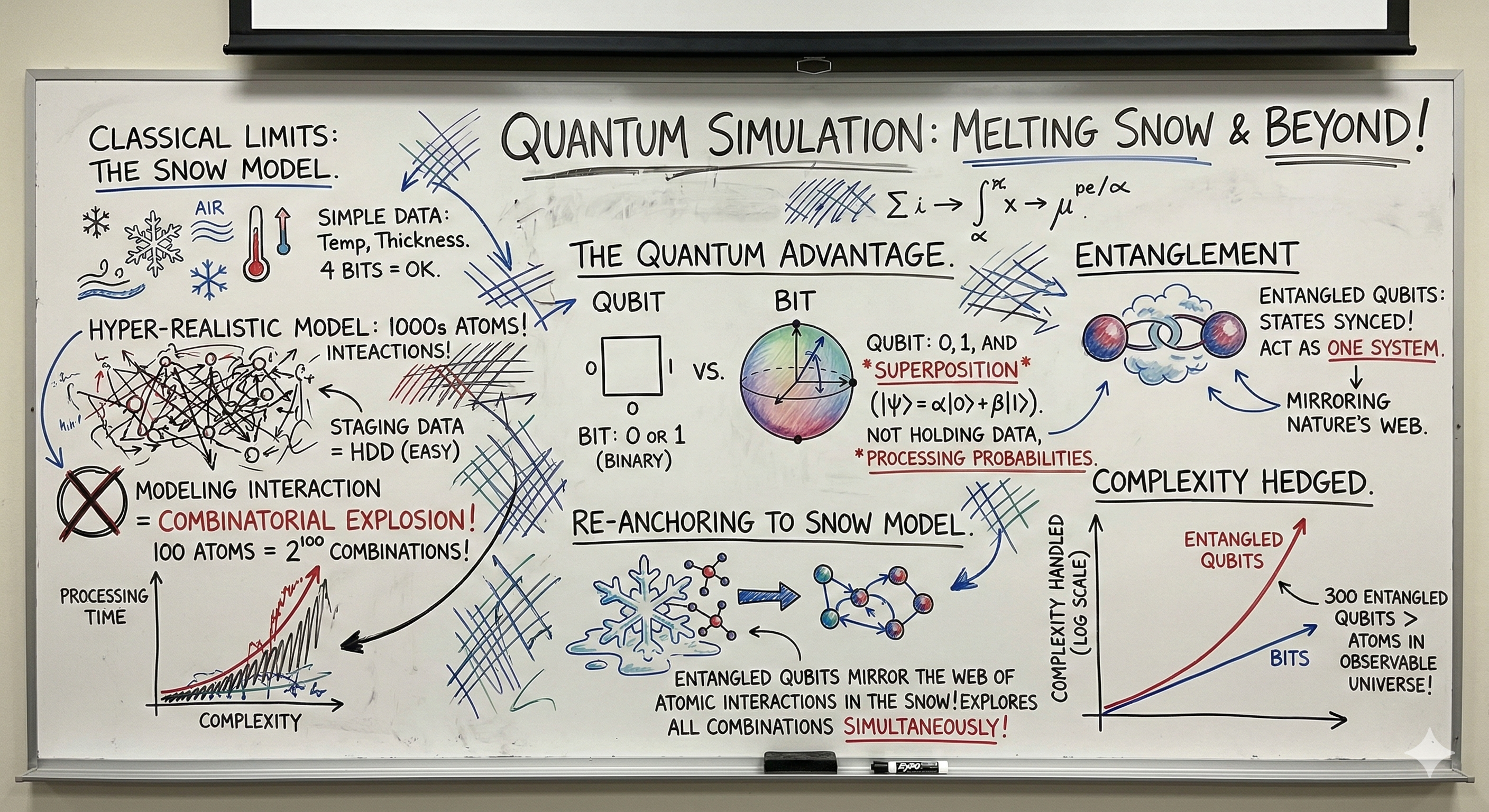
Let’s say we want to create a system that models how snow melts. In its simplest form, you have very few data points, like the temperature of the snow and the temperature of the air. As time progresses, you calculate a simple melt rate. To get more accurate, you add more variables: the thickness of the snow, surface area, direct sunlight, etc. As you add more, your model's predictions improve.
To get hyper-realistic, you have to take into account an incredible amount of data—tracking snow in microscopic, discrete units, analyzing how different pockets of air affect local temperatures, and so on. We can continuously improve our model by adding more variables, eventually reaching the goal of modeling every single atomic unit of the snow and air.
The Classical Bottleneck: The Combinatorial Explosion
Here is where we hit a wall with classical computing. The issue isn't storing the data; a standard hard drive can easily hold the static information of billions of individual atoms. The problem is calculating the interactions.
As our snow model improves, we need to see how every atom impacts every other atom, as well as how groups of atoms impact other groups.
Classical computers use bits (which are strictly binary—either a 0 or a 1) to process these interactions sequentially. They calculate how Atom A interacts with Atom B, then Atom A with Atom C, then A, B, and C together. By the time you are trying to simulate the complex web of millions of interacting snow and air atoms, you run into a "combinatorial explosion." The number of possible configurations is so unfathomably large that even the most powerful classical supercomputer on Earth would take millions of years to calculate every outcome. Processing all those combination states requires a number of traditional bits that simply isn't physically feasible.
The Quantum Solution: Processing the Entire Web
This is where quantum computers come in. They don't try to store more data; they fundamentally change how we process those massive webs of interactions using a qubit instead of a bit.
A classical bit is strictly a 0 or a 1. A qubit, however, can exist as a 0, a 1, or a fluid combination of both states at the same time (a property called superposition). Because of this, a qubit can process a vast number of probabilities simultaneously before collapsing into a single, highly optimized answer when we finally measure it.
The real magic happens when you link these qubits together through something called entanglement.
If you take our snow simulation, entangling the qubits perfectly syncs them up so the state of one qubit instantly influences the others. They don't have to check the atomic interactions one by one. Instead, the entangled qubits act as a single, unified system that physically mirrors the complex web of the melting snow.
It explores the entire web of those interacting atoms all at exactly the same time. You aren't just holding more data; you are navigating an infinitely more complex web of relationships in a single computational step. Because of this exponential scaling, a quantum computer with just around 300 perfectly entangled qubits can explore more unique combination states at once than there are atoms in the observable universe.